How Robotics Builds Mathematical Intuition in Young Learners
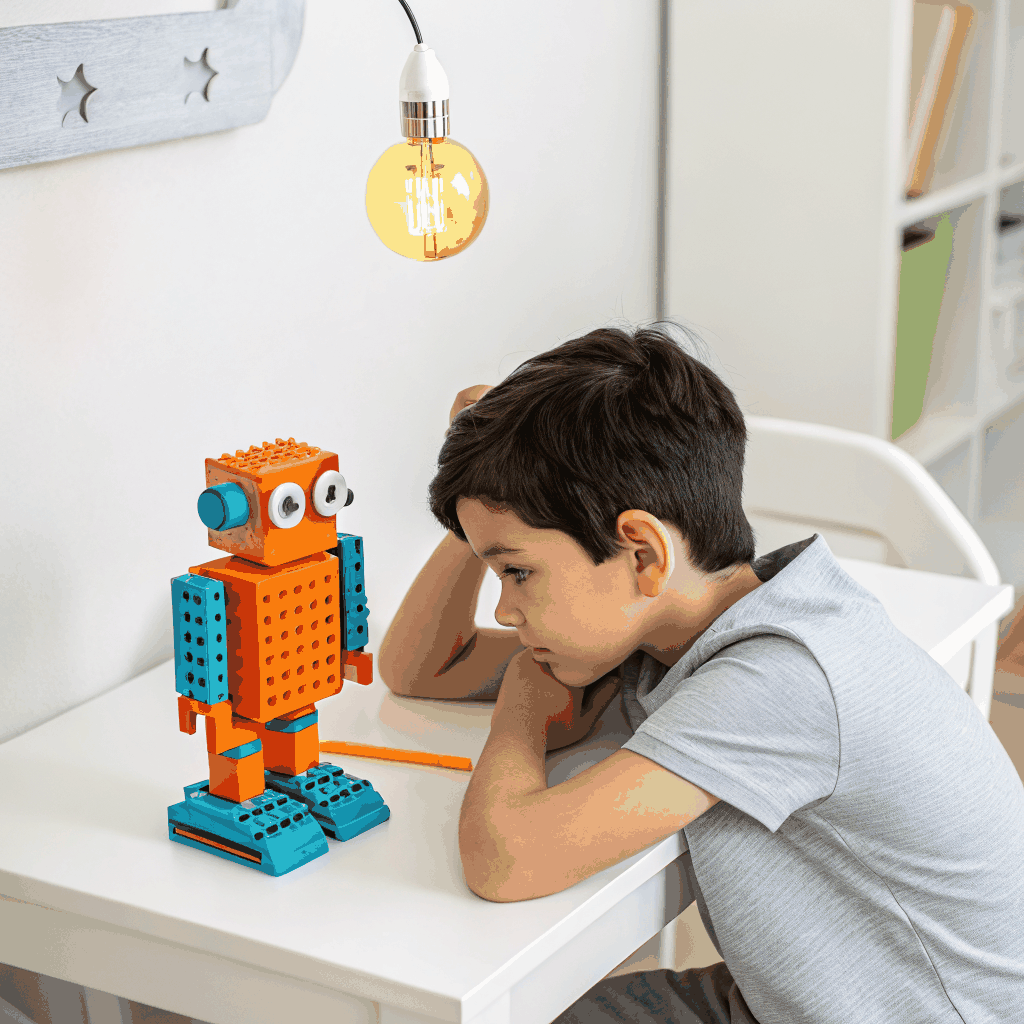
The Hidden Math Behind Every Robot
When a child snaps together gears, programs a sensor, or calibrates a motor, they are doing math—often without realizing it. Robotics turns abstract numbers into tangible actions, giving young learners a concrete playground for developing number sense and spatial reasoning.
- Counting and sequencing: Building a robot requires counting parts, ordering steps, and tracking loops in code. Each iteration reinforces the concept of “one more” and the structure of arithmetic sequences.
- Measurement and scaling: Determining wheel diameter, gear ratios, or arm length forces students to measure, compare, and convert units, sharpening their ability to visualize dimensions.
- Proportional thinking: Adjusting speed versus torque introduces ratios and fractions, helping learners grasp how parts relate mathematically.
From Code to Calculus
Even simple block‑based programming languages embed core algebraic ideas:
- Variables act as placeholders for unknown values, mirroring algebraic symbols.
- Conditional statements (if/else) teach logical operators and set theory basics.
- Loops illustrate repeated addition and the concept of series.
When a child programs a robot to follow a line, they must calculate sensor thresholds, a process akin to solving an inequality. This hands‑on problem‑solving nurtures critical thinking and prepares them for more advanced topics like geometry and calculus.
Why Robotics Boosts Spatial Reasoning
Designing a robot’s chassis or arranging LEGO bricks demands three‑dimensional visualization. Learners practice:
- Rotations and translations: Understanding how a gear turns or a arm pivots builds mental models of geometric transformations.
- Symmetry and patterns: Recognizing repeating structures in circuitry reinforces pattern recognition, a key skill in mathematics.
Practical Tips for Parents and Educators
- Integrate math talk: Ask “How many wheels do we need?” or “What angle should the arm turn?” during build sessions.
- Use data logs: Have students record sensor readings and plot them, turning raw numbers into graphs.
- Encourage iteration: Celebrate failed attempts as opportunities to refine calculations and improve designs.
By embedding mathematics in the excitement of robotics, we give children a playful yet rigorous foundation for lifelong STEM learning.